Mostrando las entradas con la etiqueta Mundo. Mostrar todas las entradas

domingo, mayo 03, 2009

Under the Magnifying Glass | Brzezinski: the G-2, not the G-20, could “change the world” | La Jornada, Mexico

By Alfredo Jalife-Rahme, English translation by Gerardo Alejos.

With the sadly comical exception of [Mexico’s President Felipe] Calderon and his team of the “best economists of the world”, it should be noted that less than a month after the dysfunctional G-20 summit was held –in both senses of the word– in London, the Anglo-Saxon power spheres do not seem pleased with the results of the summit.

The British press –at large– has shown a healthy dose of skepticism; a prime example of this is Martin Wolf, editor of economy of The Financial Times, the mouthpiece of neoliberal globalization. Five days after the summit, the newspaper filed away the news stories on the G-20 and focused on the G-2 [relationship] as the tightrope of the global financial crisis.

Henry C. K. Liu –born in Hong Kong, a Harvard-graduated architect and urban planner who started an investment firm in New York, also a prolific contributor to the Asia Times Online site– finally brought up, with a 3-month delay (4/22/09), Zbigniew Brzezinski’s bold proposal to create a G-2 between the US and China, which “could change the world.” (Brzezinski was a national security advisor to president Jimmy Carter and is now a member of [President Barack] Obama’s closest circle of advisors). 

Liu reports that Brzezinski “made his proposal for a US-China G-2 in a speech delivered during a conference in Beijing on January 13, 2009, a week before Obama was scheduled to be inaugurated as president, to commemorate [sic] the 30th anniversary of the establishment of diplomatic relations between the US and China.”

The details, which may seem boring, are actually crucial: “the conference was sponsored by the Chinese People's Institute of Foreign Affairs and the Kissinger Institute on [sic] China and the United States, and co-sponsored by the National Committee on US-China Relations, with support from both the US Embassy in Beijing and the Chinese Ministry of Foreign Affairs.”

The “large US delegation” was led by former president Carter –“during whose administration diplomatic relations were established”–, former secretary of State, Republican Henry Kissinger, and former national security advisors Brent Scowcroft (R) and Brzezinski (D), who were “formally received” by President Hu Jintao, Vice President Xi Jinping and Premier Wen Jiabao.

In the formal abstract of Brzezinski’s conference, which he published in The Financial Times (1/13/09), Brzezinski recalls that Carter sent him “to China in 1978 to initiate the secret negotiations that resulted in the normalisation of US-China relations.” He then speculates that “our world is different, better (supersic!) and safer (extrasic!) because of that normalisation.” Can anyone believe him?!

He says that “the effect” of this cooperation on security matters, which strengthened both countries, “was to change the cold war’s global chessboard –to the disadvantage of the Soviet Union.” The legendary russophobia of the Polish-Canadian-American Brzezinsky comes to the fore, as well as the proverbial perfidiousness of Kissinger, who fooled the naive soviets time and time again while selling them out to the Chinese.

According to Brzezinski, “indirectly (sic), the normalisation facilitated Chairman Deng Xiaoping’s decision to undertake a comprehensive economic reform.” It is clear, as I’ve said before, that the Chinese reforms in order to relatively open its market were not created in a vacuum; they were the result of a geostrategic settlement between the US and China against the USSR, something that [former president Richard] Nixon and Kissinger had already negotiated since 1972 –so Brzezinski shouldn’t take full credit on this.

And it is even clearer that Kissinger and Brzezinski are two sides –a Republican and a Democrat one– of the same coin: the geostrategic irredentism of the US.

Brzezinski weighs up the present situation of the bilateral relations and cites the Liaowang magazine (7/14/08), which describes the present relation between the US and China as a “complex interdependence, in which both sides evaluate each other in pragmatic and moderate terms and in which the two sides can compete and consult within the existing international rules.”

Then Brzezinski wrote a sentence that has upset the Chinese geostrategists: “a globally ascending China is a revisionist power (supersic!) in that it desires important changes in the international system.” But he softens his blow and also theorizes that China seeks for changes “in a patient, prudent and peaceful fashion.” This represents the exact opposite of [former president George W.] Bush’s take-over tactics which Obama is epiphenomenologically [incidentally] distancing himself from, as of today.

He infers that China has changed more than the US: “Chinese strategic thinking has moved away from (…) global class conflict (sic) and violent revolution,” and China is “peacefully rising” in global influence while seeking a “harmonious world”.

Brzezinski is fixated on the term “global”. In his [most notorious] book (“The Grand Chessboard: American Primacy [sic] and its Geostrategic Imperatives [sic]”), the term “global” [actually] represents Washington’s power, which he believed would last forever –he wrote the book 13 years ago, during the era of unipolar paroxism–; however, [the truth is that] the US power is speeding towards an implosion.

Brzezinski also says that the “North Korea nuclear programme” is one of the areas in which both US and China can “cope with residual or potential disagreements.” And he adds that as long as the US and China understand “the centrality” of their “interdependence”, they will “be able to cope with other contentious issues.”

Always leaning towards megalomania, Brzezinski proposes a “shared grand goal” that will “widen and deepen [the US-China] geostrategic co-operation, beyond the immediate need for close collaboration in coping with the economic crisis.” Yet [it seems clear that] finance and economy are not Brzezinski’s areas of expertise, so he prefers to leave those matters to Obama’s monetarist triplets: Summers-Geithner-Bernanke, who do not seem prone to negotiating with China.

Brzezinski comfortably defines the three areas of “grand geostrategic cooperation”: 

1) [China’s] direct participation in the dialogue with Iran; 

2) [the participation of China in the] consultations and then [in the] informal mediation regarding India and Pakistan, and 

3) the resolution of the Israeli-Palestinian conflict.

These three areas seem to represent Brzezinski’s diplomatic “carrot”. If it fails, it might be followed by a military “stick”, in which China would suffer the most lethal consequences, which –we venture to say– would be:

1) “oil-related consequences” –given the possible interruption of the oil supply in the “Greater Middle Eastern” region, which includes Iran–, and

2) “nuclear consequences” –the “regional calamity” that would occur if a nuclear conflict breaks out between India and Pakistan, two countries that border China–.

Under the explicit threat of the Huntingtonian clash of civilizations, lies the US’ highly lethal capacity to cause damage to China in the “Greater Middle Eastern” region –specifically in Palestine, Iran and the Indian subcontinent– if China does not accept the G-2 model.

Will China once again accept the Faustian pact proposed by Brzezinski –and seconded by Kissinger– in order to –once again– besiege Russia? What would happen to multipolar harmony?

- Originally published in the column Bajo la Lupa of the newspaper La Jornada, April 26, 2009, Mexico City.

domingo, abril 26, 2009

Under the Magnifying Glass: LEAP/Europe 2020 forecasts the imminent breakdown of the dollar | La Jornada, Mexico


By Alfredo Jalife-Rahme, English translation by Gerardo Alejos.

Just like the monetarist bailouts endeavored by the Paulson-Bernanke couple during the twilight of [George W.] Bush’s second term were a failure, the neoliberal bailouts implemented by the Summers-Geithner-Bernanke triplets during the first 100 days of [Barack] Obama’s term seem to have been unsuccessful. And Obama himself seems to have been kidnapped by the Wall Street bankers/beggars, according to Simon Johnson (former chief economist of the International Monetary Fund in 2007 and 2008, and current professor at MIT’s Sloan School of Management) in a chronicle of the “quiet coup” undertaken by US bankers, who “captured” the US government and are currently “blocking recovery” (The Atlantic Monthly, May 2009).

Twenty days after the dysfunctional G-20 summit held in London on April 2, the only summit participant who insists on living completely away from the very delicate reality is [Mexico’s President Felipe] Calderon –delusionally sheltered in his team of the “best economists of the world”–, while the out-of-sight, controversial and misogynous Larry Summers, the main “economic” counselor of his –actual– hostage Obama, admits that there’s a risky uncertainty sailing over the US skies (The Daily Telegraph, 4/20/09). In this regard, we strongly recommend the critique of the G-20 summit that Immanuel Wallerstein published on his website (commentary no. 255, 4/15/09 ).

European think tank LEAP/Europe 2020 correctly forecasted three years ago the present global tsunami which is barely starting, or rather, which is only beginning to enter its second phase –since we still haven’t seen the collapse of the ominous derivatives known as credit default swaps, valued in over 60 trillion dollars, more than the annual global GDP–. LEAP/Europe 2020 has conscientiously earned its position as an invaluable reference for “realist” economic analysis, and its work is miles ahead from the prevarications and chimeras propagated by most of the Anglo-Saxon media –and the risible local media caricatures that lack judgment and discernment–.

This column was perhaps the first one in the Americas to discover the oracular virtues of LEAP/Europe 2020, which are based on hard data, so we have been commenting its monthly findings for a rather long time. For instance, last year we ventured to reproduce its daring forecast of the breakdown of the dollar, which would occur in the summer of this year.

In my recent visit to Paris, just before the London summit, I was surprised to find an “open letter” from LEAP/Europe 2020 to the G-20, signed by the think tank’s Director of Studies Franck Biancheri, published as a one-page spread in The Financial Times -the foremost mouthpiece of global neoliberalism- (“Last chance before global political dislocation”, 3/24/09)

Biancheri raised an unavoidable dilemma to the G-20: “a 3- to 5-year crisis or a decade-at-least long crisis”, given that the “engine” of the global economy can’t be repaired; therefore it’s imperative to build a new engine based on three basic recommendations that should be implemented before this summer: 

1) the creation of a new international reserve currency; 

2) setting up bank control schemes, and 

3) an IMF (sic) assessment of the banking systems of the US, Great Britain and Switzerland (i.e. [the countries that foster the financial policies that spurred the crisis, such as] bank secrecy, the gambling of financial derivatives in the invisible books of tax havens and the immunity of bankers).

To focus on the imminent breakdown of the dollar, we’ll center on the first recommendation that Biancheri characterizes as “very simple” and that, in our judgment, could lead to a world war for it undermines the last bastion of the US power (Bajo la Lupa, 4/12/09): “the US dollar and economy are no longer capable of supporting the current global economic, financial and monetary order”, and this problem lies “at the heart” of the global crisis and its “consequences in terms of mass unemployment and collapsing living standards.”

LEAP/Europe 2020 champions [once again] the creation of “an international reserve currency (which could be called the «global») based on a basket of currencies corresponding to the world’s largest economies, i.e. US dollar, euro, yen, yuan, khaleeji (common currency of oil-producing Gulf states, to be launched in January 2010), ruble, real..., managed by a «World Monetary Institute» whose board will reflect the respective weight of the economies whose currencies comprise the «global».”

Biancheri’s letter ominously concludes that, if this recommendation is not implemented, “today’s international system will not survive this summer,” because each country will behave based on “the «every man for himself» approach”, and those countries or institutions that intend to maintain their status quo will “lose any capacity” to “significantly influence the future shape of this new global monetary system,” given the “political dislocation.”

With this somber background, LEAP/Europe 2020, in its GEAB bulletin no. 34 (4/16/09), enunciates the relentless onward motion of the “Western system breakdown” and mocks the “dollar trap” in which China appears to have fallen –which it supposedly can’t break free from–, according to the notorious assertions of Paul Krugman (New York Times, 4/02/09). China’s plethoric reserves, of course, amount to 2 trillion dollars, and 70% of those reserves are in dollars and the remaining 30% in euros. But is China trapped with no way out?

According to LEAP/Europe 2020, China, like any other prisoner, dreams of escaping its dollar-centric prison, which will occur “by the end of the summer of 2009”, when the US will declare the bankruptcy of the dollar given its defaulting on its debt. Then, each country will act according to its self-interests with the purpose of prevailing in the international system.

China is getting prepared for this ominous contingency. In the first quarter of this year, the growth of its foreign reserves invested in US Treasury –and other US– bonds (i.e. in dollars) significantly slowed down (Chinese Central Bank, April 2009).

Beyond the dire internal divisions in the G-20 and the “pusillanimity” of the “Eurozone leaders”, LEAP/Europe 2020 “anticipates the different forms a US default will take at the end of summer 2009, a US default which can no longer be concealed from this April (most taxes are collected in April in the US) onward.”

Regarding the manipulation of the price of gold, the European think tank explains that “the perspective of a US default this summer is becoming clearer as public debt is now completely out of control with skyrocketing expenses (+41%) and collapsing tax revenues (-28%).” At the federal, state, county and town levels, “tax revenues are vanishing, suffocating (sic) the whole country with spiraling debts that no one can control anymore, not even Washington.” However, the most interesting aspect herein is the reaction of the US citizens, who have begun to rise up against the use of their tax dollars to bail out the speculative blunders of the blood-sucking, parasitical bankers.

- Originally published in the column Bajo la Lupa of the newspaper La Jornada, April 22, 2009, Mexico City.

lunes, abril 20, 2009

Under the Magnifying Glass: Obama faces Latin America’s new-found multipolarity | La Jornada, Mexico


By Alfredo Jalife-Rahme, English translation by Gerardo Alejos.

Barack Obama faced in Trinidad and Tobago –where he enthusiastically advocated Cuba’s triumphant return [to the OAS]– a majority of 31 Latin American heads of state; their position was very different to the heart-warming entreguismo [appeasement, submissiveness] of [Mexico's President Felipe] Calderon, who is shamelessly handing over the Mexico/US border –and its natural gas fields– to the NORAD/Northern Command US couple –although it is only fair to note herein the connivance of the PRI [Mexico’s Institutional Revolutionary Party] Congress leaders, [Senate leader Manlio Fabio] Beltrones and [Chamber of Deputies leader Felipe] Gamboa Patron.

Calderon has exaggeratedly militarized all civil activities in Mexico, a formerly pacifist and peaceful country whose army used to be trained to maintain peace, and he has turned Mexico into the “guinea pig in the Pentagon’s irregular war” (Bajo la Lupa, 4/15/09).

In complete agreement with Mexico’s military annexation to the Pentagon, Calderon embraced the bloodthirsty neoliberal energy agenda of the US –a key point of [former president Vicente] Fox’s SPP: the Security (super sic!) and Prosperity (super sic!) Partership of North America– by means of the controversial measures regarding the emission of greenhouse gases, and has completely forgotten to even mention –much less demand the demolition of– the shameful border wall that Baby Bush unilaterally militarized.

Sailing against the global historical tide, Calderon –who turned out to be more of an ardent fan of the outdated NAFTA than Obama– is sinking along the Titanic-like decrepit unipolarity of the US, and he hasn’t figured out yet that most of the other Latin American leaders are leaning toward multipolarity. Calderon clearly doesn’t understand the meaning of “competitiveness,” a word that he spouts non-stop, as “neoliberal Mexico” still holds a mediocre global position.

So, just like Obama found that most of the 31 Latin American heads of state were far-removed from Calderon’s unipolar dependence, the Latin American leaders –as a whole– found that Obama was extremely eager to reconcile the US with Latin America, and that his position was decidedly different to Baby Bush’s unilateralism.

This fifth Summit of the Americas is very different to its first edition in Miami, in 1994, when then-vicepresident Al Gore launched the now-extinct Free Trade Area of the Americas (FTAA), laid to rest by the creative Latin American heads of state in the 4th summit that was held in Mar del Plata [Argentina], where the laughable Fox-Martita [i.e. Martha Sahagún, Vicente Fox’s wife] couple antagonized most delegates –including Cristina Fernandez, before she became president of Argentina–.

In the fourth summit, Baby Bush used the loquacious Fox as a Trojan horse to undermine the Latin American cohesion that heroically rejected a suicide that the poisonous FTAA was about to cause.

But in this fifth summit, Calderon has found it impossible to market the exaggerated militarization and narcotization –in both senses of the word– of Mexico –which nominally affects our civil democracy and human rights situation– and his neoliberal handing over of Mexican oil, as the only model that should be followed by the other Latin American countries, most of which are already on the path of being freed from the US economic and financial custody –i.e. the Monroe doctrine– in the new multipolar era.

Obama became aware of three different [ideological] positions in Latin America: 

1) Calderon’s position, which is unacceptable for most of Latin America, a region in which “neoliberal Mexico” is becoming increasingly isolated; 

2) the position of the Bolivarian Alternative for the Americas (ALBA, in its Spanish acronym), very daring and creative in geopolitical terms given its multipolarity; these countries are willing to negotiate with Obama without surrendering to the US unipolarity, while building bridges with Europe, the Middle Eastern, Africa, China, Russia and India; and 

3) Brazil’s position, somewhere in the middle of the FTAA and the ALBA, with the strikingness of representing one of the emerging powers of the 21st century, along with the RIC countries –Russia, India and China–.

Given the way in which Obama organized his group meetings in Puerto España, he visibly accepted the existence of three geoeconomic regions in Latin America: South America, Central America and the Caribbean –where “Calderon’s Mexico”, with its shameful border wall, is totally adrift after placing its highest bet on the failed North American integration, which –at most– will be relevant in terms of people and immigration.

It is undeniable that after 100 days of his arrival into the White House, Obama is still on a global honeymoon –shared with his wife, Michelle–, reflected in the “Obama-mania” that has just reached Latin America. But curing the wounds that Baby Bush has inflicted througout the world –particularly in Latin America– won’t be an easy task.

The Obama administration is distressed by the ongoing loss of its position, not to say its leadership, in Latin America, so in this fifth summit it has summoned all of its seductive power in order to carry out a Latino perezagruska: the reactivation of the relationships with Latin American countries.

Obama is already aware of the impossibility of “Calderonizing” the remaining Latin American countries, most of which are more assertive and self-assured than ever.

Behind the seductive reconciliation represented by the “Obama-mania”, through which the US is temporarily playing a defensive role in Latin America, lies the nefarious intention of the US to stop, and even to Balcanize, the astounding expansion of the ALBA, formed by Venezuela, Cuba, Bolivia, Dominica, Nicaragua and Honduras, with Ecuador and Paraguay as guests.

Obama’s problem is that “Calderon’s Mexico” is not attractive or marketable [as a Latin American model] – in a marketing sense, it is even counterproductive–, so the Obama administration is on the quest to find easily-adaptable governments –such as Colombia, Peru and Chile– in order to create an anti-ALBA partnership under the military guidance of the US.

As I write this column, Obama hasn’t brought up in the summit Bush’s idea to create a new forum for the countries of the Americas, based on the “Pathways to Prosperity (super sic!) in the Americas” (White House communiqué, 11/24/08), as a disguised attempt –a new “pathway”?– to resurrect the deceased FTAA, so that it would counterbalance the South American integration being carried out by the Union of South American Nations (UNASUR, in its Spanish acronym), which is likely to become one of the main geopolitical poles of the planet, in the 21st century.

Two days after the mentioned White House communiqué [was issued], the ALBA creatively upped the ante with its single currency project –the “sucre”–.

Calderon’s neoliberal and submissive speech during Obama’s visit to Mexico was a vulgar reproduction of several of the seven points of Bush’s “Pathways to Prosperity in the Americas” communiqué, which was originally issued in New York city with the consent of heads of state and delegates from Canada, Chile, Colombia, Costa Rica, El Salvador, US, Guatemala, Honduras, Mexico, Panama, Peru and the Dominican Republic.

Upon the risk of being immolated in the hells of history, several of these countries, either due to pressure or repression, will gladly become members of an alliance against the ALBA and, if possible, against UNASUR.

Be that as it may, most of Latin America has decisively turned toward multipolarity. And now Obama knows it better than anyone else.

- Originally published in the column Bajo la Lupa of the newspaper La Jornada, April 19, 2009, Mexico City.

domingo, abril 19, 2009

Under the Magnifying Glass: Mexico, ¿the first guinea pig in the Pentagon’s shift to irregular warfare? | La Jornada, Mexico


By Alfredo Jalife-Rahme, English translation by Gerardo Alejos.

First off, some background: last year, in the presence of Mexico’s Senate leader Manlio Fabio Beltrones [PRI], Bob Gates, then George W. Bush’s Secretary of Defense (who was confirmed in his oversensitive position by Barack Obama), promised during a Washington conference that Mexico would be incorporated into the North American Aerospace Defense Command (NORAD), as long as the Merida Initiative was approved in the Mexican Congress. Maybe [Mexico's President Felipe] Calderon and Beltrones are not aware that NORAD was used during the Cold War as the nuclear defensive shield of the US and Canada (two NATO members) against the former Soviet Union.

Notwithstanding the notorious entreguismo [appeasement policy] of “Mexico’s ambassadors” in Washington –Jesus Reyes Heroles Jr., his “political consultant” Luis Carlos Ugalde Ramirez (infamous after the devastation of the Federal Electoral Institute [Mexico’s independent electoral body]), and the [former Mexican ambassador to the US Jorge] Castañeda-disciple Arturo Sarukhán Casamitjana–, or the coreographic variations between the Republican and Democratic parties, ¿why is the Pentagon upraising NORAD in the post-Cold War era, with the strange inclusion of Mexico?¿Does the Mexican “governing class” know that Mexico’s espousal of the Pentagon’s military theorems –the war on drugs, the war on Islamic terror, NORAD– will force our country to share the global enemies that the US has duly earned throughout the years in Eurasia, Africa, Europe and Latin America?

Now, the facts. “The ancient route of the perverse men” had already been traced, as French philosopher René Girard would have said, upon the following events: 

1) the incorporation of [1994-2000 president Carlos] Salinas’ Mexico to BushDaddy’s NAFTA –a resounding failure, according to top US academic centers–; 

2) [2000-2006 president Vicente] Fox’s acceptance of the SPP –the Security (super sic!) and Prosperity (super sic!) Partnership of North America, which served as a cover-up of the handing over of Mexico’s oil and which hasn’t provided “security” or “prosperity”, as it can be easily witnessed in Mexico’s territory–; 

3) and now Plan Mexico (a clone of the failed Plan Colombia), only renamed as the Merida Initiative.

The three phases –NAFTA, SPP and the Merida Initiative– are part of the US unilateral agenda imposed to a castrated, archaic Mexico in which the [former Secretary of the Interior] Joseph Marie Cordoba-[former president Ernerto] Zedillo couple, along with their allies [Central Bank president] Guillermo Ortiz Martinez, [former Secretary of the Treasury] Angel Gurria, and the Werner Wainfield brothers –Alejandro, Mariano and Martin, currently one of the directors of Banca Mifel (Voces del Periodista, no. 2007, 4/01/09) and a Goldman Sachs’ employee–, successfully dismantled the Mexican financial system, now obscenely controlled by the Wall Street-City axis.

After the Merida Initiative was approved by the Calderon-Beltrones Congress, Bob Gates is fulfilling his Bush-era promise and has set up the stage, in the Obama administration, in order to incorporate “neoliberal Mexico” to NORAD, as detailed in the analysis by European military think tank De Defensa (4/09/09).

According to it, the Pentagon “is equating Mexico with the Southern border of the US in the cheerful (sic) planning of the war on drugs”, as corroborated by general James E. “Hoss” Cartwright during the April 6 conference in which Secretary of Defense Bob Gates set out his budget proposal for next year.

General Cartwright, a strategist of military globalization, was a US Marine and is second in command to admiral Michael Mullen, Chairman of the Joint Chiefs of Staff. When asked by a journalist to comment on “Mexico’s participation, for the first time in history, in some binational military exercises in Florida” under the authority of the Southern Command, a brazen General Cartwright confirmed that the “cooperation” (super sic!) will be “both at the service level, for training, and then at the operational level, with the Commander of NORTHCOM, for support in the drug conflicts that Mexico’s working its way through but also for general support in the Mexican government's ability to defend its country (extra sic!).” 

Apart from the Hollywoodesque Al-Qaeda threats to Pemex, is there any country or coalition of cartels expressing interest in invading Mexico, while Calderon and [current Secretary of the Treasury Agustin] Carstens affirm that Mexico’s team of the “best economists of the world” is handling the crisis well? The double “support” disclosed by General Cartwright, the unexpected “saviour” of Mexico and its oil, while the US plays as almighty God, “will be more robust (sic) than it has been in the past, by a significant (sic) amount.” [De Defensa] made a very serious charge: “the Pentagon is making the decisions regarding operational cooperation and it has lobbied in order to pressure the Mexican army to accept them.” So, wasn’t it Calderon’s, Beltrones’ and Sarukhan’s initiative that the Northern and Southern Commands defend the Mexican territory and its oil?

The new Pentagon, with a limited budget due to the two-fold financial and economic crisis of the US, has set the stage to carry out a new type of irregular warfare [also called “fourth generation warfare”] (Bajo la Lupa, 12/07/08), and Mexico will be its first guinea pig on a global scale. Nothing is new anymore.

The cheerful General Cartwright did not even attempt to hide the new Pentagon’s “transition” toward irregular warfare, which includes Calderon’s war on drugs -and its hidden agenda of handing over oil and the Mexican security through military force-, which requires specific training and equipment that will be provided by our neighbor and saviour, the US. 

De Defensa is amazed at the “remarkable density” of General Cartwright’s response and makes a scathing comment: “this is the Mexican army being publicly involved in an exercise with the US army.” So long for discretion and caution, let’s welcome instead a joint operation under the two-fold pincer-like command of the Northern Command -for the war on drugs in the Mexico/US border and its shameful wall- and the Southern Command -for the defense of the Mexican territory-.

Could it be that the US, in a clear stage of decadence, fears that some of its innumerable global enemies could infiltrate its Southern border and/or the Caribbean, its two most vulnerable spots? Is the Pentagon advancing its defensive lines toward the Panama Canal, connecting Plan Mexico with Plan Colombia? Will this end up gobbling Mexico and the small countries of the Caribbean and Central America?

[De Defensa] writes that “the Mexican armed forces will have to follow the new U.S. doctrine that will be developed - but without discussion (sic).” It also suggests that the dispute over the border is “a step toward the annexation to the Pentagon,” and that it is also a “great test for a new doctrine” through which the military presence of the US will now be “structurally massive.” It is not for nothing: this new doctrine traps Mexico under the only two operational commands of the US for the Americas. Is Mexico the new tectonic plate –in geopolitical terms– between the decadent North and the rising South of our fractured American hemisphere?

- Originally published in the column Bajo la Lupa of the newspaper La Jornada, April 15, 2009 , Mexico City. 

sábado, abril 18, 2009

Under the Magnifying Glass: The decrepit, dollar-based financial order still prevails | La Jornada, Mexico


By Alfredo Jalife-Rahme, English translation by Gerardo Alejos.

In my recent lectures –at the international conference of the Partido del Trabajo [Mexico’s Labor Party] in Mexico City, on March 21, and at the Lebanese American University in Beirut, on April 3 (at the invitation of doctor Imad Salamah)– I have detailed the existence of a hybrid three-dimensionality in the “new multipolar order”, an order that has both bipolar and unipolar factors: 

1) in regard to geostrategy, the US and Russia are on equal nuclear terms after the Russian response to the agression of Georgia toward South Ossetia –China is a distant third place given its satellite launch and its immense growth–; in this scenario, unless a third world war breaks out, as coveted by the Anglo-Saxon banking system, the world will be a relatively peaceful place provided that none of the top players suffer from an internal dislocation; 

2) in terms of geoeconomics, the trends are very clear: the G-7 will slope down and the BRIC countries (Brazil, Russia, India and China) will move upward along with the oil nations of the Persian Gulf, among which Iran stands out –in this regard, we should also mention the Barack Obama-led strengthening of Turkey, in order to replace a weakened Israel as the US stronghold in the Middle East, and to counteract the Russian redeployment along the Black Sea–, and 

3) in regard to geofinance (a term coined by Under the Magnifyng Glass, reproduced by the Anglo-Saxon press without referencing the source), the dollar hegemony refuses to give up its undeniable power: this makes it the most unstable and dangerous component of the hybrid tridimensional world order.

In geostrategic terms, this “new multipolar world order” came about in August 2008, when Russia repelled Georgia’s agression in South Ossetia (which was instigated by the US and Israel). In the geoeconomics sphere, it could be argued that it started in the Spring of 2004, when the Anglo-Saxon couple [the US and the UK] evidenced its powerlessness to control Irak’s oil production which, in a certain way, gave rise to the serendipitous and irresistible positioning of the BRIC economies. 

Only the geofinancial aspect remains freestanding; whether we like it or not, the hegemony –so as not to say the unipolarity– of the US dollar prevails in spite of the global financial tsunami caused by the US, itself a former unipolar superpower. 

The prevalence of the dollar-centrism, furtively underpinned by the G-20 summit in London, could be the biggest tragedy of the 21st century: a currency with no economic guarantees, which is only functional because it can’t be replaced in the short term. The US nuclear bombs will now protect the dollar.

No BRIC country has a currency that could replace the dollar in the short term: the Russian ruble and the Brazilian real, two “convertible” currencies, are far from competitive against the dollar, while the Chinese yuan and the Indian rupee are not still “convertible” and do not pose any threat for the US, a country whose currency still is –against all odds– the basis of the world’s monetary reserves, and a country that still prints bills at an irresponsible and hyper-inflationary pace.

The decrepit, 65-year old geofinancial world order stands still. As we have suggested (Under the Magnifying Glass, 03/25/09), the “new global geofinancial order” must be multipolar and it must reflect the new correlation of forces in the geostrategic and geoeconomic spheres. Easier said than done, though.

One of the imponderable weaknesses of the BRIC countries is their financial underdevelopment against the Anglo-Saxon predominance, while the main markets of the latter (Wall Street and the City) still hold the first two places in the financial development index of the World Economic Forum in Davos, that also ranks the G-7 countries and their tax havens in the top positions.

Whoever wins a world war gets to impose a financial order that works in their best interest –such as the trans-Atlantic invasion carried out since the XVII century by Holland, Great Britain and the US–, as proved by Giovanni Arrighi and Beverly J. Silver in Chaos and Governance in the Modern World System (1999), a book we strongly recommend in order to understand the dynamics of the old (now dollar-centric) Anglo-Saxon financial world order.

Adam Posen, deputy director of the influential Peterson Institute for International Economics and former economist of the Fed, shamelessly states that “the role of the dollar is a geostrategic (super sic!) and monetary matter” (Le Monde, 03/30/09). He discards the Chinese proposal –championed by Russia– of the creation of “a global reserve currency” in order to replace the US dollar: “the US government has every reason to believe that the dollar must remain as the reference currency in international trade. It is a geostrategic and monetary matter. It offers greater security (sic) in the global economy to the US.” He also deplores that neither Joseph Stiglitz –Nobel prize of Economy and a supporter of the revamping of the international monetary system– “or anyone else (sic)” have presented “a clear alternative for the current system,” and concludes that “neither the Americans or the Europeans (sic) are willing to give up any share of their control (super sic!) over the international financial institutions.”

It is clear that the last bastion of the geofinancial unipolarity of the US is the dollar, and that none of the BRIC countries is willing to undergo a third world war in order to impose a monetary cosmogony. It seems as if the BRIC countries were just waiting for the entropy of the dollar on account of the military and economic decadence of the US, a former unipolar superpower, so they are only proposing watered-down adjustments to the old international monetary order instead of creating a new one.

From a geostrategic perspective, it seems that the world –instead of becoming multipolar– has returned to a nuclear bipolarity between the US and Russia, while the new players –such as China and India– are still far from the top. 

Strictly speaking, the only true “multipolarity” is taking place in the geoeconomic arena: emerging countries hold 32% of global GDP (of these, the BRIC countries produce 13% of global GDP), the European Union has 31% and the US retains 25%. This geoeconomic aspect represents the operational matrix of the new world order, which maintains its old character in the geofinancial field, given that the dollar prevails over the rest of the currencies, amounting to 66.5% of the world's reserves and commercial exchanges, vis-a-vis the Euro’s 24.4%, the sterling pound’s 3.7%, the Japanese yen’s 3.6% and the 1.7% shared by the remaining currencies. To be honest, the British pound and the Japanese yen are appendages of the dollar-centrism. And according to a severe charge published by the European think tank LEAP/Europe 20/20 (GEAB bulletin no. 33, 03/15/09), the Anglo-Saxon axis seems to be trying to Balkanise and vulcanize the Euro.

The world is now sailing in a hybrid three-dimensionality with a unipolar dollar-centrism that may well cause a shipwreck.

- Originally published in the column Bajo la Lupa of the newspaper La Jornada, April 12, 2009 , Mexico City.

viernes, junio 27, 2008

Monsiváis sobre el narcotráfico en México y el "Plan Mérida"

Ante la reciente aprobación del (para nosotros los yucatecos, ultra vergonzosamente llamado) "Plan Mérida", con el que EEUU dará créditos a México por más de $400 millones de dólares para lidiar con el narcotráfico, vale la pena recordar estas palabras de Carlos Monsiváis durante una entrevista con la BBC de Londres el año pasado.

BBC: Si uno no fuera mexicano, ¿cómo tendría que ver o cómo podría explicarse la realidad política que vive México?

Monsiváis: Si uno fuera mexicano, cual es mi caso, ¿cómo podría explicarme lo que no entiendo o lo que no me explico? La realidad política mexicana se me escapa porque elementos muy diversos confluyen y no logro jerarquizarlos.

Lo primero es la inercia que dejó el PRI. Setenta y un años de un autoritarismo monolítico, ramplón, con grandes zonas de corrupción (no digo que todos los priistas fueron corruptos, desde luego que no, pero que el PRI se asentaba en la corrupción desde luego que sí), con elementos represivos de distintos niveles, con oportunidad hasta cierto momento de movilidad social, con una tendencia secularizadora. Todo eso es una carga inercial fuerte.

En segundo lugar, y te digo sin que haya orden jerárquico, ante la idea de que ya que el empleo se vuelve una especie en extinción Estados Unidos se convierte en una tierra promisoria, y la migración alcanza niveles idílicos.

Aunque se sepa -y con detalle- del racismo, de las dificultades, de los hostigamientos, etcétera, se supera todo eso porque se piensa que detrás está el empleo, un empleo que permitirá en esta versión del imaginario la construcción de una familia y las ventajas para los hijos.

En tercer lugar, hay una atomización de la política que ha llegado a enormes niveles de desprestigio, casi todos muy justificados, y que alcanza a casi todos los partidos políticos.

En cuarto lugar, la emergencia de una derecha bastante cerrada, muy atrasada y decidida a recuperar lo que perdió en las guerras de la reforma liberal y a hacerse justicia por propio saqueo.

Y en quinto lugar una izquierda que social y culturalmente es de lo más significativo que hay y que políticamente es un atraso.

Ésos son algunos de los elementos. A esto hay que agregar las dificultades con que la globalización procede y el enfrentamiento a la desigualdad.

Si quieres un rasgo definitivo, esencial, es la desigualdad. No se puede avanzar parejamente ni mucho menos, y aunque ningún país ha conseguido eso, tanta desigualdad sí hace que el avance que se ve, que puede ser verificado, se vaya volviendo polvoso o se vaya desvaneciendo con gran frecuencia, porque no puede ser que una minoría progrese y una mayoría se sumerja.

No hay tal cosa como el avance parcial o sectorial en un país de las condiciones de México y con la vecindad de Estados Unidos.

¿Y el narcotráfico?

No lo mencioné por un acto esquivo de la memoria, que a veces no quiere sumergirse en la depresión.

El narcotráfico es la pesadilla mayor. No sólo involucra a una parte muy significativa de la población sino que, gracias a la introducción masiva de armas al país, el narcotráfico ha conseguido una situación espasmódica de violencia aquí sí parejamente.

El narcotráfico ha marcado el descenso de la nunca muy apreciada consideración por la vida humana. El narcotráfico ha dado las grandes señales de crueldad realmente sobrecogedora y en Youtube se han visto ejemplos que dan idea de cómo el horror puede ir todavía más a fondo.

El narcotráfico ha corrompido no sólo a grandes sectores policíacos sino a la idea que se tiene de la policía: ya es una idea corrupta de la policía corrupta.

El narcotráfico ha vulnerado a muchas instituciones, ha depreciado el valor de las fuerzas de seguridad pública, ha construido otra frontera muy a su arbitrio, y ha convertido en anécdota pintoresca (debido en gran parte al estupor con que se le contempla) la sucesión de escenas de horror.

¿Entonces habría que ver con buenos ojos -o cuando menos darle el beneficio de la duda- al Plan México o la Iniciativa de Mérida?

Así como se ha presentado, no veo yo la óptica bondadosa que se aplique. Ya en principio no ponerle Plan México para que no cargue el desprestigio del Plan Colombia es un juego semántico bastante pobre.

Pero aquí lo básico es que se presenta como un acto de caridad que espera la resurrección de la ética del país vecino.

Dar dinero para que se levante la moral, un "Lázaro levántate y anda" de una moral que se piensa aplastada por el narcotráfico, me parece lamentable.

Y me parece lamentable también que no se explica. Ese dinero que se le da al ejército, cómo se va a repartir, hasta qué punto las armas son necesarias, cuál es el nivel de enfrentamiento, no lo veo con claridad.

Porque además los grupos en abierto enfrentamiento son grupos muy pequeños, por fortuna.

Han hecho mucho daño y son para mi gusto muy siniestros en la medida en que no tienen programa, no tienen proyecto, actúan con acciones terroristas que a todos nos perjudican, y se mueven bajo el amparo de siglas a las que no les atribuyo ningún sentido.

EPR, Ejército Popular Revolucionario, ¿qué quiere decir?, no tengo la menor idea. Tengo idea de que hay restos de movimientos guerrilleros, pero en este momento qué quiere decir todo eso no sé.

El narcotráfico además le ha dado a toda la violencia un carácter tan sombrío -de por sí tiene, pero el no saber de dónde viene la violencia y hacia dónde va, el ver que gran parte del destino del país está envuelto en un torbellino de espectros no es buena noticia.

México cambió, pero no como se esperaba...

Sigue cambiando, y no como se esperaba y sí como se esperaba.

Desde el punto de vista de las profecías del acabose está cambiando como se esperaba.

Desde el punto de vista de la transición a la democracia, si queremos usar un epitafio como fórmula de bienaventuranza, no, desde luego que no.

Pero me fui por lo que llamaban antes los cerros de Úbeda.

Cuando me preguntas qué pasa con lo del Plan Mérida, yo creo que mientras no se explique, mientras no se razone debidamente cuál es el sentido de la ayuda y de qué modo se va a concretar en acciones que efectivamente detengan el trasiego de la droga, lo que vamos a ver es una ayuda tan rodeada de sospechas que se va a volver una suerte de novela policíaca.

viernes, junio 20, 2008

Se publica estudio científico sobre experiencias de pacientes al borde de la muerte

Es un fenómeno del que hemos escuchado a menudo pero nunca ha podido comprobarse: lo que experimenta un ser humano al estar al borde de la muerte. Ahora una nueva investigación científica sobre las experiencias cercanas a la muerte de pacientes en terapia intensiva, intenta responder si éstas realmente ocurren.

(El libro en cuestión) es una publicación académica escrita por una enfermera que tomó 10 años de investigación y está dirigida a estudiantes de medicina y bibliotecas universitarias. El libro cuenta las experiencias de pacientes que sufrieron infartos y estuvieron al borde de la muerte. Los individuos hablan de circunstancias en las que se vieron fuera de su cuerpo, o de un túnel que los conducía a una luz brillante donde se reunían con sus seres queridos.

En 1998 Penny Sartori, enfermera de terapia intensiva de los hospitales galeses de Singleton y Morriston, se dio cuenta de que había muy pocos datos de referencia disponibles para enfermeras y trabajadores de salud sobre este tipo de experiencias. Fue por eso que en 1998, tras obtener aprobación ética, decidió investigar lo que ocurre cuando un paciente tiene una experiencia cercana a la muerte o ECM.

Recuerdos

Sartori siguió los casos y entrevistó a unos 300 pacientes en las unidades de terapia intensiva y obtuvo 15 narraciones completas sobre este tipo de experiencias. El resultado es el libro "Experiencias Cercanas a la Muerte de Pacientes Hospitalizados en Terapia Intensiva. Un Estudio Clínico de Cinco Años".

"Llevé a cabo el estudio con una amplia variedad de pacientes en terapia intensiva, incluidos los que estaban muy enfermos pero no cerca de la muerte", dice Penny Sartori. "Obtuve los mejores resultados cuando estudié a pacientes de infarto que estuvieron al borde de la muerte".

"Al final 15 pacientes pudieron narrar sus experiencias cercanas a la muerte y descubrí que habían experimentado situaciones comunes", agrega. Sartori encontró que la gente que pasaba una ECM se veía "flotando sobre sí misma y que el techo se había disuelto".

"Los pacientes también fueron capaces de recordar con precisión lo que había ocurrido en la sala, a pesar de haber estado inconsciente y de haber tenido los ojos cerrados". Los individuos, dice Sartori, contaron asimismo que se veían viajando por un túnel hacia una luz brillante.

Algunos dijeron haberse reunido con una figura que les decía que "su tiempo no había llegado todavía" y otros se habían reunido con parientes muertos y se habían comunicado con ellos por telepatía. "Ciertos pacientes informaron que vieron toda su vida proyectada en un instante", afirma.

La autora explica que muchas de las experiencias cercanas a la muerte por lo general pueden explicarse por el efecto de las endorfinas (sustancias químicos que libera el organismo como respuesta a la ansiedad o el dolor), los niveles anormales de gases sanguíneos, o los bajos niveles de oxigeno. Sartori, sin embargo, midió estos tres factores y los tomó en cuenta cuando llevó a cabo el análisis de los informes de los pacientes.

Al final de estas ECM algunos pacientes contaron que flotaron de regreso a su cuerpo, y otros sintieron como si despertaran súbitamente.

Conciencia

Según la investigadora a pesar de que sólo 15 pacientes lograron describir sus experiencias cercanas a la muerte, cree que éstas son mucho más comunes. Sin embargo, para algunos enfermos es más difícil recordar el evento después de un episodio tan grave y de haber estado inconsciente.

"Es como cuando olvidamos un sueño al despertar", dice la autora.

Penny Sartori intenta ahora continuar investigando sobre el fenómeno de ECM y lo que ocurre con estos pacientes. "No creo que se trate simplemente de que existe vida después de la muerte", afirma la autora. "Más bien se trata de lo que es la conciencia y la forma como la definimos".

La ciencia define a la conciencia como un subproducto del cerebro, pero como señala Sartori, quizás estamos rodeados por la conciencia y el cerebro, en lugar de controlarla, es sólo un mediador o una antena.

"Es un tema fascinante -afirma la investigadora- y es muy emocionante poder seguir investigándolo".

La publicación tiene un costo de US$170.

- Tomado de BBC Mundo en Español.

jueves, mayo 08, 2008

El autobús de la filosofía


Mucho se ha hablado de que los filósofos son una suerte de niños barbados e intensivos que siguen fustigando a sus contemporáneos con preguntas infantiles de inútil o imposible resolución. Pero hasta ahora los adultos parecían haberse olvidado que de niños fueron bastante listos y que por lo menos se daban cuenta de lo que no entendían.

Ahora en Alemania, un programa de televisión quiere volver a ese punto privilegiado y ayudar a que los próximos Kants y Hegels no se queden solos con sus padres. "Próxima parada:...", así se llama el programa del canal infantil alemán KIKA.

En un bus amarillo de dos pisos, dos muchachos viajan por Berlín acompañados del creador de la serie, el conocido moderador de televisión Gert Scobel, y se topan en las paradas, o en el mismo bus, con los problemas que arrecian la existencia de los hombres.

De viaje con Kant

Para auxiliarlos, o para meterlos en problemas aún mayores, suben al bus Platón, Kant, Heidegger, Hegel, pero también científicos y pensadores surtidos.

Muerte, Amor, Miedo, el Mal, la Belleza son los corpulentos temas de los primeros capítulos de la serie y que figuran como destinos del bus.

En Amor, los muchachos se encuentran con un investigador alemán que afirma que el ser humano se enamora mucho más fácilmente cuando está en una situación de peligro. Pronto sube Aristóteles al bus y declara que el amor entre amigos es el amor máximo, aún más allá que el amor de una pareja.

Luego una serie de dibujos animados ilustra algunas teorías del amor en varios filósofos, mientras que una niña de 9 años habla de su amor por un compañero de clases y su ostensivo fracaso.

"Más allá"

En el capítulo "Más Allá" está el tema de la muerte, guiada por Platón, que defiende la inmortalidad del alma. Los niños ven las fiestas del día de los muertos en México, hablan con un profesor de química molecular que les explica cómo es que el cuerpo muere y hablan con dos niñas sobre cómo enfrentaron la muerte de su abuelo.

Al bus sube sólo quien quiera hablar directamente. Pensadores, filósofos y científicos alemanes discuten o explican directamente a los niños sus tesis, sin tecnicismos y en un tono informal.

No hay respuestas definitivas, sólo se trata de enfrentar a los temas con las muchas y variadas respuestas que los pensadores les han dado en el transcurso de la historia a niños que son poco o nada ayudados por sus mayores.

En los primeros ensayos los creadores de la serie se toparon con un problema inesperado: los niños se quejaron de que habían demasiadas ilustraciones y que lo que les interesaban era lo que decían los filósofos.

El programa ha tenido mucho éxito entre los niños de hasta 12 años, que son su objetivo y se planea hacer una nueva serie de capítulos. Los padres esperan impacientes y nerviosos.

- tomado de BBC Mundo en Español.

miércoles, abril 30, 2008

Albert Hofmann [1906-2008]

Descanse en paz el gran viajero accidental, inventor de la dietilamida del ácido lisérgico, que vivió hasta los 102 años. Uno de los grandes iconos del desarrollo de la conciencia humana, sin duda alguna. La ilustración es un homenaje a Hofmann hecho por el también genial Alex Grey.

miércoles, abril 23, 2008

Sexo público en los parques de Ámsterdam

Ámsterdam analiza la posibilidad de ir más allá de la revolución sexual iniciada con la proliferación de vitrinas en su famoso "barrio rojo", donde las mujeres venden sexo a los transeúntes con todas las de la ley.

Ahora, las autoridades de la capital de Holanda han iniciado un debate para establecer un marco legal que permita o castigue tener sexo en los parques públicos de la ciudad. Particularmente en el más famoso, el Vondel. Y es que cuando anochece, el parque principal de Ámsterdam, es punto de encuentro de hombres homosexuales que buscan sexo rápido y sin compromiso.

"No está penalizado tener sexo en el parque, pero tampoco está permitido. Cuando la policía descubre a una pareja in fraganti, sólo le llama la atención y le pide retirarse", dijo a BBC Mundo, Herbert Raat, portavoz de la Alcaldía de Ámsterdam. "Ahora estamos discutiendo la posibilidad de darle un marco legal, ya sea para que se prohíba o se permita por ley. Así que estamos escuchando todos los puntos de vista para llegar a una conclusión", agregó.

Reglas del juego

El detonante del debate fue una iniciativa diseñada por el concejal Paul van Grieken, del Partido Verde, quien en un documento estratégico titulado "Utilización del Vondel", propone permitir la práctica del sexo en este lugar. El proyecto plantea una serie de reglas. Por ejemplo, sólo se permitiría tener sexo al caer la noche, lejos de las zonas destinadas a los niños y de una manera discreta.

El Vondel no sólo es el jardín más grande, sino el más agradable de la ciudad, al ser punto de encuentro de familias con niños, deportistas, ancianos y enamorados que pasean entre rosales y estanques. De prosperar la propuesta, el Ayuntamiento considera que podría entrar en vigor durante el próximo verano.

Posturas encontradas

Más de 70% de los habitantes de Ámsterdam afirma que no tiene problemas con los homosexuales que buscan sexo en los parques públicos, según una encuesta realizada a solicitud de la televisora local AT5. En tanto, el 37% de los encuestados opina que podría permitirse tener relaciones sexuales en el Vondelpark, mientras que 35 responde que no con firmeza.

El legislador Pieter den Geel, líder del partido democratacristiano CDA, rechaza la idea y se pregunta: "Si tomamos ese deslizadero, ¿a dónde iremos a parar?.

Caja de Pandora

El mexicano Jorge Vargas, quien vive en Ámsterdam desde hace 26 años, asegura que la Alcaldía abrirá "la Caja de Pandora" si autoriza el sexo en el Vondel. "Están en un gran dilema, porque si lo permiten, se echarán a todo el mundo encima", sostiene.

Otros grupos reclamarían igualmente derechos, como es el caso de los nudistas que no pueden asolearse sin usar ropa interior o los jóvenes miembros de brigadas de scout, quienes no tienen permiso para acampar de noche. Incluso las personas con perros podrían reclamar que sus mascotas puedan andar sin cadena por el parque sin riesgo a ser multados.

"Todo esto es parte del juego de la democracia y lo abierta y tolerante que es la sociedad holandesa", expresa Vargas.

-- tomado de BBC Mundo en Español. La imagen es una fotografía de Spencer Tunick tomada en (precisamente) el Vonfeldpark de Ámsterdam, tomada de este blog.

jueves, abril 17, 2008

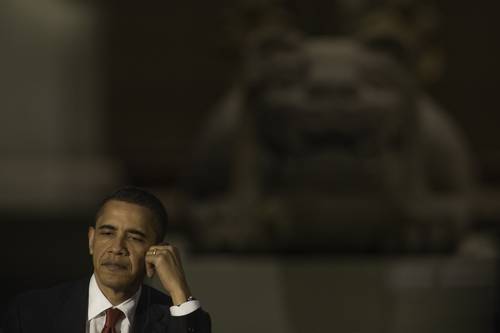
Obama pide disculpas por llamar "amargados" a los estadounidenses de bajos ingresos


"Lamento haberles dicho que son amargados y que están aferrados a la religión, las armas y la antipatía hacia quienes no son como ustedes.

(en el globo) No me conviene en lo más mínimo causar la ira de violentos racistas y fanáticos religiosos".

miércoles, abril 16, 2008

El año pasado se descubrió un planeta habitable fuera de nuestro sistema solar

Un equipo internacional de astrónomos descubrió el que aseguran es el planeta más parecido a Tierra que se conoce hasta ahora. Está fuera de nuestro sistema solar y, según los científicos, tiene las características de un planeta habitable.

El exoplaneta -como se les llama a los planetas fuera de nuestro sistema solar- tiene un radio 50% mayor que la Tierra; además, tiene capacidad de contener agua líquida y, por lo tanto, de ser habitable, dicen los astrónomos.

El equipo de científicos suizos, franceses y portugueses descubrió la "Supertierra" utilizando el telescopio del Observatorio Europeo Austral (ESO). "Es la primera vez que descubrimos un planeta como éste" dijo a BBC Ciencia Xavier Bonfils, del Observatorio Astronómico de Lisboa en Portugal, y uno de los astrónomos que participó en el hallazgo. "Y creemos que contiene agua líquida porque tiene la masa adecuada y la temperatura correcta", afirma el astrónomo.

El planeta tiene 5 veces la masa de la Tierra, y orbita una estrella enana roja llamada Gliese 581, que se sabe tiene una masa igual a la de Neptuno. Los astrónomos señalan que también encontraron evidencia de la presencia de un tercer planeta, que es ocho veces más grande que la Tierra.

Extrasolar

El nuevo exoplaneta es el más pequeño que se ha descubierto hasta ahora en ese sistema, y puede completar la órbita alrededor de su sol en 13 días.

Tal como explica Xavier Bonfils, su sol, la estrella enana Gliese 581, es mucho más pequeña y fría que nuestro sol y por lo tanto menos luminosa. "Es por eso que a pesar de que el expolaneta se encuentra 14 veces más cerca de Gliese 581, el planeta se ubica en una zona que podría ser habitada", afirma el astrónomo. Ésta es una región alrededor de la estrella donde el agua puede ser líquida.

"Calculamos que la temperatura promedio de la Supertierra es de entre 0 y 40º centígrados, es por eso que el agua allí podría ser líquida", señala Bonfils. "Y creemos que su superficie podría ser rocosa -como la Tierra- o cubierta de océanos", agrega.

Vida

Como se sabe, el agua líquida es un elemento fundamental para la vida, tal como la conocemos. Es por eso que los astrónomos creen que, debido a su temperatura y su relativa proximidad, el planeta podría ser en el futuro el objetivo de misiones espaciales para buscar vida extraterrestre.

"Si tuviéramos un mapa del tesoro del universo -dice el astrónomo- este planeta sin duda estaría marcado con una X", dice Xavier Bonfils.

La estrella huésped Gliese 581 es una de las 100 estrellas más cercanas al Sol. Está localizada a 20,5 años luz del Sol en la constelación Libra y su masa es de sólo una tercera parte del astro centro de nuestro sistema planeterio.

Este tipo de estrellas rojas enanas emiten 50 veces menos luz que el Sol y son las estrellas más comunes de nuestra galaxia.

"Es un descubrimiento muy importante y creemos que puede haber muchos más planetas como éstos", dice el astrónomo. "Y en el futuro nuestro objetivo es buscar indicadores de vida en la atmósfera de estos planetas", señala.

Hace dos años, el mismo equipo de astrónomos descubrió otro planeta alrededor de Gliese 581 y creen que el sistema planetario que rodea a la estrella está formado de al menos 3 planetas mucho más grandes que la Tierra.

Es por eso, dicen, que se trata de un sistema solar extraordinario.

- Nota del 17 de abril de 2007, tomada de BBC Mundo en Español.

martes, abril 15, 2008

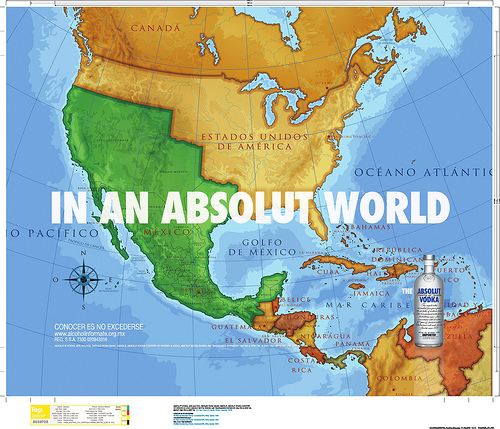
El póster de la discordia


Este póster, aunque nunca fue exhibido en Estados Unidos dado que estuvo dirigido al mercado mexicano, fue retirado inmediatamente por Absolut luego de las protestas de los sectores gringos más conservadores.

¿Mi opinión ante todo esto? Como le dije una vez a mi broder Jeff (genial artista visual), no me molestaría que los gringos nos devolvieran California, tierra tan hermosa. Pero que se queden con Texas.

Esto me recuerda que hoy en la noche me tomaré un vodka tonic.

lunes, octubre 08, 2007

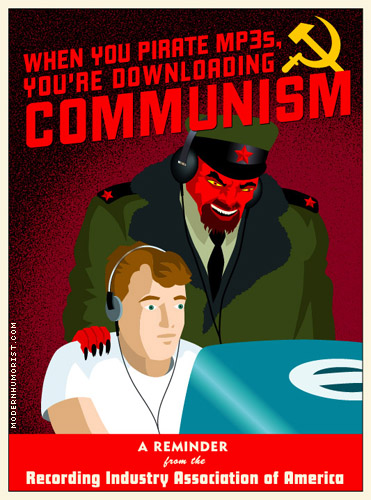
Un mensaje de la Asociación Estadounidense de la Industria Fonográfica

Y también de asquerosos bastardos como Lars Ulrich de Metallica, Dr. Dre, Britney Spears, Creed, etc.:

viernes, agosto 31, 2007

Campeonato mundial de barbas y bigotes

Recomiendo ampliamente visitar la galería de fotos del sitio BBC Mundo en Español sobre el campeonato mundial de barbas y bigotes de 2007, celebrado este año en la ciudad de Brighton, Inglaterra. A continuación uno de los competidores más exitosos:

lunes, julio 09, 2007

Una pareja estonia gana el Mundial de "cargar a la mujer"

SONKAJÄRVI, Finlandia (AFP) - Un total de 55 parejas reunidas en una pequeña localidad de Finlandia participaron el sábado bajo la lluvia en el campeonato del mundo de "llevar a la mujer", que este año se adjudicó una pareja estonia, constató AFP.

La prueba, una carrera de obstáculos de 253.5 metros que los hombres deben recorrer en el menor tiempo posible con una mujer sobre ellos que pese al menos 49 kilos, fue seguida por cerca de 3,000 espectadores.

Al atravesar un hoyo con un metro de agua de profundidad, la mayoría de las mujeres tuvieron que aguantar la respiración, ya que la postura más adoptada en la carrera era en la que la mujer va a la espalda del hombre con la cabeza hacia abajo y las piernas alrededor del cuello del hombre.

La 12a. edición de este insólito campeonato del mundo la ganó una pareja estonia que confirmó el dominio del país báltico en el torneo, ya que llevan ganando el título mundial desde 1998.

Inga Klauson y Madis Usorg realizaron el mejor tiempo (61.7 segundos), seguidos de otra pareja estonia, Kristi Viltrop y Alar Voogla (64.4 segundos). Los finlandeses Kristiina Haapanen y Taisto Miettinen quedaron terceros (64.7 segundos).

La recompensa de esta prueba organizada todos los años en Sonkajärvi (a unos 650 kilómetros al norte de Helsinki) es el peso de la mujer ganadora en cerveza.

Las 55 parejas venían de 16 países, entre ellos España, Australia, Corea del Sur, Estados Unidos, Francia, Gran Bretaña, Irlanda, Italia, Japón, Rusia y Sudáfrica.

- Nota verídica tomada de Noticias Yahoo.

miércoles, julio 04, 2007

¿Estresado? Destruye un hotel

Julio tiene 38 años, acaba de tener mellizos, y ya no soporta el trabajo que hace en el departamento de mercadotecnia de una empresa informática.

Este martes tomó un martillo y destruyó el bar y la habitación 207 del hotel NH Alcalá de Madrid. "Me saqué el diablo", declaró Julio a BBC Mundo. Pero no estaba solo.

Un jurado de la cadena hotelera seleccionó a Julio y a otras 29 personas dispuestas a demoler parte de uno de sus hoteles para contrarrestar el estrés. Eduardo Bartolomé, portavoz de la cadena, dijo a la BBC que los elegidos tuvieron dos horas y asesoría de albañiles para destrozar tanto como pudieron en un piso del hotel en el centro de la capital española.

Los organizadores recibieron más de 200 solicitudes de personas que buscan reducir su nivel de tensión nerviosa, entre ellos empleados con bajos salarios y madres que trabajan y necesitan "darle un golpe a algo". Entre los estresados también hubo estudiantes (sobre todo de ingeniería), ejecutivos de empresas trasnacionales y novios que están organizando su boda.

Los seleccionados recibieron martillos hidráulicos y otro tipo de herramienta pesada para destruir lo que encontraran en una zona de la recepción y el primer piso del hotel, que la empresa piensa remodelar. Su pago será una cena y una noche en el hotel cuando termine la rehabilitación del edificio en septiembre.

"Te visten de mono, te dan guantes y herramientas y descargas toda la adrenalina hasta quedar agotado", narró Julio. "No aguantas más de dos minutos".

Julio, quien volvió a fumar después de tres años y medio, se ríe cuando BBC Mundo le pregunta qué le dijo su esposa cuando supo que se presentaría como voluntario para la demolición. "Me dijo que no me hiciera mucho daño", dijo Julio entre risas. "Y que esperaba que volviera tranquilito".

- Historia verídica tomada de BBC Mundo en Español (pueden ver videos de la destrucción del hotel en el link anterior).

lunes, marzo 19, 2007

Dos videos de la respuesta policiaca a la protesta contra Bush del martes 13 de marzo de 2007

En el primer video, prácticamente todo ocurre en los bajos del Palacio Municipal de Mérida, y algo en el patio interior. El segundo video es en realidad una sucesión de fotos de prensa. Creo que es indispensable poder ver cómo suceden estas cosas.


jueves, febrero 22, 2007

Encarcelan a blogger egipcio por "insultar" a su religión y a su presidente

Un tribunal de la ciudad egipcia de Alejandría sentenció este jueves a Abdel Karim Suleiman, un blogger de 22 años, a cuatro años de prisión por ocho artículos publicados en internet en 2004. Suleiman fue hallado culpable de insultar a la religión musulmana y al presidente Hosni Mubarak.

Ésta es la primera vez que se sentencia a un blogger en Egipto, a pesar de numerosas peticiones internacionales para que sea liberado.

Suleiman, un antiguo estudiante de derecho de la Universidad islámica de Al Azhar, ha estado bajo custodia desde noviembre pasado y es el primer blogger que comparece ante la justicia egipcia por sus escritos. Es musulmán, pero liberal, y acusó a su alma máter, la sede del pensamiento islámico sunita, de fomentar ideas extremistas. En otro de sus artículos, titulado "La verdad al desnudo sobre el Islam como lo vi", acusó de salvajes a los musulmanes que se enfrentaron a cristianos en Alejandría en el 2005. Suleiman, también conocido por su nombre de pluma Karim Amer, calificó de terroristas a varios compañeros del profeta Mahoma y asemejó al presidente Mubarak a los faraones que gobernaron el antiguo Egipto como dictaduras.

"Esta sentencia es otra bofetada contra la libertad de expresión en Egipto", dijo Hassiba Hadj Sahraoui, directora de Aministía Internacional para Africa del Norte y Medio Oriente, quien considera que el blogger es "un prisionero de conciencia perseguido por la expresión pacífica de sus puntos de vista".

El gobierno egipcio recientemente inició una campaña contra bloggers políticos, que entraron en escena luego de criticar al régimen de Mubarak durante las elecciones del 2005, y más recientemente por documentar serios casos de represión policial.

Pero, ¿qué piensan los bloggers del veredicto? Dalia Ziada, blogger y activista, señaló que el equipo de defensa presentará un recurso de apelación ante el veredicto.

Alaa Seif es otro blogger egipcio cuyo popular sitio web (casi todo en egipcio) muestra su inconformidad y la de su joven esposa, Manal, sobre el sistema egipcio. "En primer lugar, no es ninguna sorpresa. Esperábamos una sentencia severa. Es normal que haya sido sentenciado por la religión, de hecho nunca ha habido un veredicto de inocencia para quien insulte a la religión", dijo Seif a BBC Mundo. Y agregó que "el insulto al presidente es un cargo sumamente político. Es muy preocupante y entristecedor y eso afecta a todo mundo. Habrá efectos inesperados y escalofriantes, ya que hay muchos casos de periodistas bajo este mismo cargo que esperan su veredicto pronto."

- Tomado de BBC Mundo en Español.

lunes, enero 29, 2007

Las mujeres más bellas de la política mundial

Mis nominadas:

3) Ségolène Royal, la nueva candidata del partido socialista a la presidencia de Francia, quien nos recuerda al famoso poema de Enrique González Rojo que hablaba de una mujer que "tenía las piernas más hermosas de todo el movimiento comunista mexicano". Si doña Ségolène gana, creo que será necesario que un servidor aprenda la lengua y visite Francia por primera vez.

2) María Consuelo Araújo Castro, ministra de relaciones exteriores de Colombia y ex ministra de cultura (guapa e interesante). Aunque no comparto para nada su ideología (la del presidente Uribe, cachorro de EEUU), miren nada más qué belleza, cómo posa como una modelo. Claro que estamos hablando de Colombia, en donde todas las mujeres son bellas (lo comprobé en persona el año pasado).

1) Pero la reina de todas las reinas de la belleza política a nivel mundial es la exquisita Yulia Timoshenko, ex primera ministro de Ucrania y quizás la única líder mundial que ha salido en la portada de Elle. Lo que hace tener vodka en los genes. Vean eso nada más; por ella me vuelvo ucraniano y me inscribo a un gulag sin pensarlo.

Aceptamos sugerencias.